
Locating the source of a problem
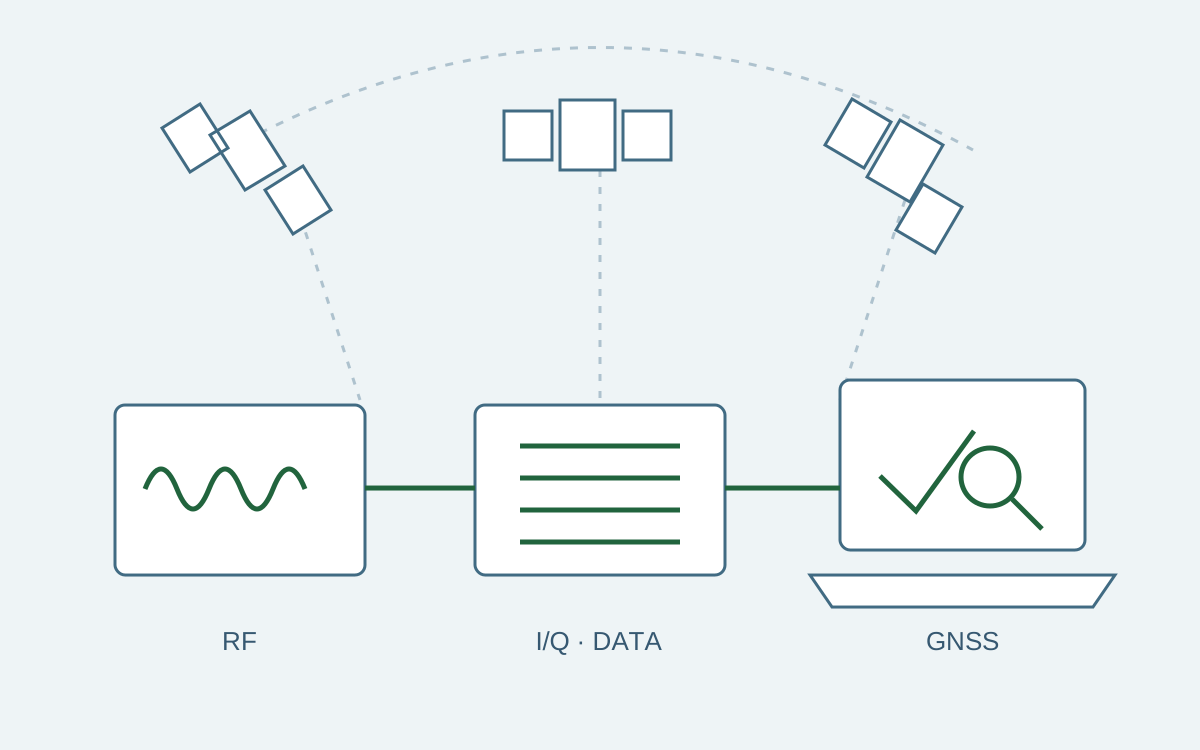
A satellite reception system connects sample acquisition, data transport and software that reconstructs a position solution. When the expected result is missing, verification needs to make each part’s contribution identifiable.
During 16–21 November, we worked both on tests with receiver data and on a software transport prototype. These paths answer different questions and provide different evidence.
Porting to RADXA ROCK 3A and a new front-end architecture
Work on the reception chain also covered porting the system to RADXA ROCK 3A and defining a new front-end architecture with a high-frequency switch for each channel.
Porting brings attention to the interfaces between acquisition, transport and the application. Keeping these layers identifiable connects work on the host platform to checks on individual parts of the chain. These are development activities, distinct from the results already observed on the signal.
Testing the signal and navigation software
The tests recorded on 16 November isolated a polarity issue in the Q component of the I/Q samples. After the correction, recovery of the position solution was observed.
A later change addressed timing in the NMEA bridge, with dedicated tests and regressions. Distinguishing acquired samples from messages produced by software makes it possible to follow the data along the chain.
What simulated sources can verify
The subsequent phase, documented on 20 November, concerns a transport prototype with a simulated USB source. Tests cover commands, interfaces and software-module behaviour, including Windows and Linux checks and memory-checking tools.
A simulated source makes many cases repeatable without depending on the receiver or acquisition conditions. The result is useful for software checks and regression testing; physical-chain qualification requires tests with the actual hardware.
Recording the boundary of each result
To describe progress, we record the configuration tested, what was observed and which components were real or simulated. This makes later tests comparable and helps determine the next integration step.
It is part of our AI-assisted development and verification approach: every result retains the context in which it was obtained.