
Three different projects, one shared approach
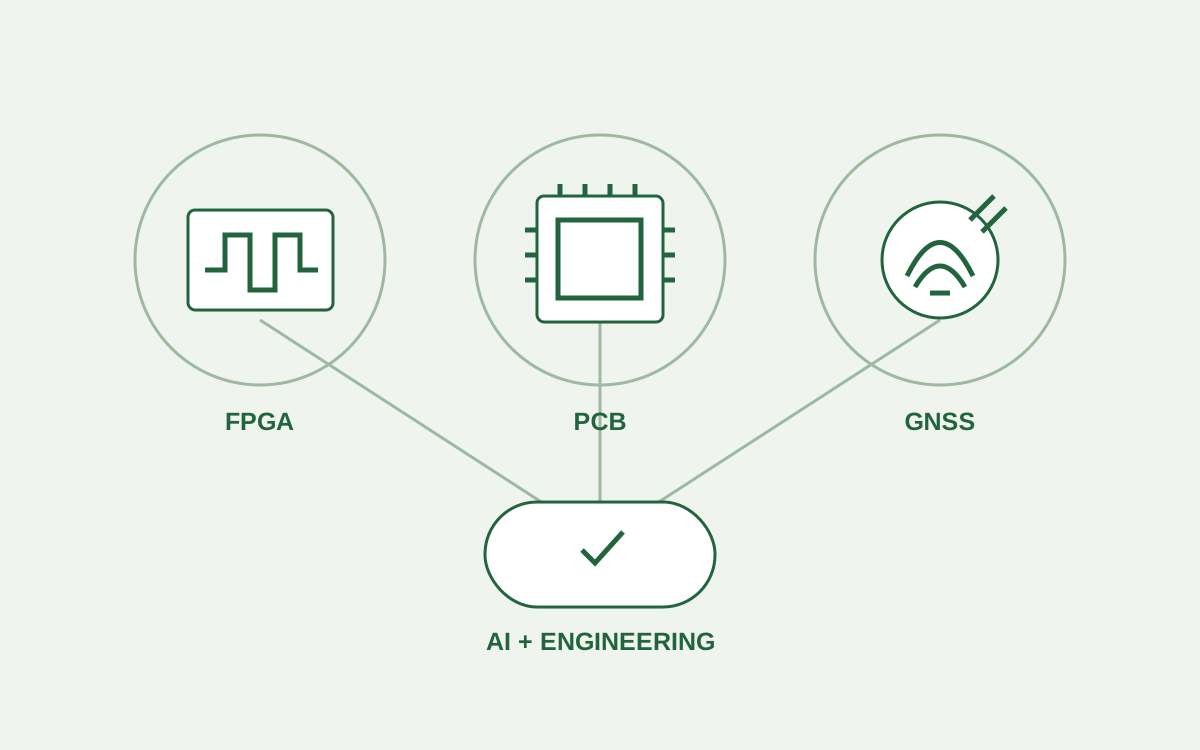
During 16–21 November, we worked on three areas: an FPGA bench for generating and analysing position signals, the transition from a development board to dedicated electronics, and a satellite reception chain. The technical problems differ, but each requires consistent requirements, code, interfaces and test evidence.
We use artificial intelligence to support analysis, source code and test preparation, and documentation. Our aim is to tackle more engineering work while reducing repetitive tasks and the time required to prepare and review a solution. Engineering decisions and verification remain the responsibility of the team.
An FPGA bench, from the browser to the signals
The first project connects browser-based configuration, sequences stored in memory and FPGA logic that generates timed edges. The processor handles configuration and telemetry, while hardware executes the sequences.
The tests covered CSV profiles, channels with independent repetition periods, and position reconstruction from emulated signals. Results can be checked in the interface and in captures from the internal logic analyser.
From the bench to a dedicated board
For the second project, we compared development-board schematics, configuration and firmware already exercised on the bench, and the hardware of the previous system. Moving to dedicated circuitry requires identifying dependencies that software functions or an emulator may leave hidden.
The hardware definition includes 20 identified requirements and 16 planned checks.
Satellite reception and software verification
The third project follows samples from the receiver to the software that interprets them. Recorded tests isolated a data-polarity issue and confirmed that a position solution could be recovered. A subsequent change addressed timing in the bridge carrying navigation messages.
Work also covered the evolution of the host platform and front end. The GNSS article describes the RADXA ROCK 3A port and high-frequency switching per channel in more detail.
We also documented tests of a software transport prototype using a simulated USB source. These tests help check interfaces and regressions and must be distinguished from tests with the physical receiver.
A like-for-like cost comparison
For one activity, we prepared two quotation alternatives with the same technical scope, deliverables and planned tests.
| Item | Traditional approach | AI-assisted approach |
|---|---|---|
| Estimated effort | 40 person-days | 17 person-days |
| Planned duration | About 8 weeks | About 4 weeks |
| Services | €14,800 | €6,290 |
| Dedicated AI environment | Not included | €400 |
| Quoted total | €14,800 | €6,690 |
These are alternative quotations, not final costs. The figures relate to the specific scope of this offer. They are not a general price list or evidence of a saving already achieved. Actual costs will need to be compared when the work is complete.
More development with explicit verification
Development work can be reviewed by a tester separate from the person or agent that prepared it. Code, documents, simulations and bench captures provide different kinds of evidence, each with its own limits. An observed anomaly becomes a new engineering task.
For a business commissioning development, this makes the discussion more concrete: functions, deliverables, tests, progress and budget can be considered alongside the tools used to produce them.
If you are considering custom electronics or embedded software, tell us about your system’s requirements and constraints.